
Consistency. Precision. Adaptability. Companies that need thermoforming want these qualities in a company they can depend on. Our team at Neodesha Plastics Inc. delivers engineered plastic components through a streamlined thermoforming manufacturing process designed for speed, repeatability, and cost control. Businesses with demanding quality standards, especially those supplying OEMs, depend on our expertise as a trusted plastic thermoforming company to move products from prototype to production without compromising performance or timelines.
Thermoforming combines the flexibility of modern plastics with the efficiency of scalable production, allowing manufacturers to create complex, durable parts. It allows for a lightweight design and improved part performance while reducing overall tooling costs compared to injection molding. Thermoforming is a cost-effective production method, offering low-cost manufacturing solutions that make it ideal for affordable, custom plastic parts across a range of industries.
Our process works for real-world production challenges. As a U.S.-based plastic thermoforming company, we provide responsive engineering support, efficient prototyping, and dependable scaling for medium- to high-volume runs. Whether you develop enclosures, trays, housings, or large covers, our flat-sheet thermoforming capabilities help you stay agile in competitive markets. We have the ability to create large parts, accommodating a variety of shapes and sizes thanks to the flexibility in design that thermoforming provides. Thermoforming is well-suited for large parts such as vehicle panels, equipment housings, and pallets. We deliver high-quality results backed by technical expertise and transparent collaboration.
Our customers use thermoforming because it stands out for its balance of cost efficiency, scalability, and design precision. Compared to alternative manufacturing methods such as injection molding, plastic thermoforming services offer significant savings due to lower tooling expenses, shorter lead times, and adaptable mold configurations.
Modern thermoforming systems consume up to 30 percent less energy than previous generations, as they use more advanced heating controls and optimized compressed air systems, making thermoforming a practical choice for low- and high-volume production. Our systems also maintain tight dimensional control and repeatable quality standards. Dimensional accuracy is critical in custom thermoforming, ensuring every part meets exact specifications and consistent tolerances for reliable, cost-effective production.
Thermoforming’s ability to produce durable, lightweight components without sacrificing surface quality streamlines assembly and downstream processes, ensuring manufacturers can respond to demand fluctuations and product design updates more efficiently.
The thermoforming manufacturing process offers an ideal balance between performance, customization, and cost management. Custom thermoforming services provide tailored solutions for OEMs and tier suppliers, enabling them to address unique project requirements alongside other manufacturing and finishing processes. Unlike traditional molding techniques, thermoforming can adapt to project modifications while producing large, complex parts that meet stringent engineering specifications.
OEMs benefit from reduced tooling complexity, shorter production cycles, and enhanced design freedom. Custom thermoforming allows for a variety of design options, including complex shapes, custom compartments, textures, and detailed branding. These advantages make thermoforming an effective and strategic fit for sectors such as automotive, medical, telecommunications, and industrial equipment, where precision-engineered plastic parts must meet performance and regulatory standards.
Manufacturers and tier suppliers gain a competitive edge because of process agility, material optimization, and consistent quality delivery. It is important to note that custom tooling and design iteration can extend production timelines, and close communication between engineers and project managers is essential for meeting customer goals efficiently.

Neodesha Plastics Inc. is a trusted, centrally located thermoforming manufacturer offering custom thermoforming services for complex, high-performance plastic parts. We specialize in heavy-gauge industrial thermoforming that delivers speed, flexibility, and precision—whether you’re launching a new product or scaling an existing design.
Our custom thermoforming capabilities include:
As a U.S.-based plastic thermoforming company, we support fast iterations, low tooling costs, and scalable mid-to-high-volume production. From prototype to full production, Neodesha Plastics delivers custom solutions built for performance and reliability.
A method favored for its speed and versatility, thermoforming transforms flat plastic sheets into durable 3D components through controlled heating and molding. The seven-step process enables high-precision results for industrial and custom applications. The stages combine heat and vacuum pressure for consistent part quality.
Thermoforming includes several techniques, most commonly vacuum forming, pressure forming, and mechanical forming. Each method shapes heated plastic using different forces, vacuum, air pressure, or mechanical pressure, to achieve the desired form and detail.
The thermoforming process contains seven steps:

Material Selection
Choosing the correct thermoplastic sheet based on the desired properties, such as impact resistance, flexibility and chemical resistance.

Sheet Heating
Precisely heating the plastic sheets to the optimal forming temperature, which gives them uniform pliability.

Forming Over the Mold
Draping and stretching the heated sheet onto a custom-designed mold, using vacuum or pressure forming methods.

Vacuum/Pressure Application
Applying vacuum or air pressure to mold the material tightly against the tool, utilizing specialized tools and molds to achieve precise component formation and capture the exact surface details.

Cooling
Allowing the formed part to cool and solidify, locking in dimensional stability.

Trimming and Finishing
Removing any excess material, refining the edges and performing any required surface enhancements.

Quality Inspection
The final checks for fit, form and function prior to assembly or packaging, ensuring a high-quality finished product ready for use.
The advantages of tooling and prototyping include:

Thermoforming plays a vital role in industrial markets where durability, performance, and precision are non-negotiable. At Neodesha Plastics, we specialize in custom industrial thermoforming for sectors that demand high-quality, application-specific plastic components.
In the automotive industry, we manufacture interior trim panels, HVAC ducting, and chrome-laminated ABS components that meet stringent safety and aesthetic standards. For the medical and life sciences sector, our thermoformed parts support critical applications such as diagnostic equipment housings, sterilizable trays, and portable enclosures—all engineered for cleanability and compliance.
We also serve material handling and industrial equipment manufacturers, delivering rugged trays, protective guards, and machine housings that withstand repetitive use and harsh operating environments. With every project, we align our thermoforming expertise to the precise needs of industrial-grade production.

We offer expert thermoforming plastic services at Neodesha Plastics Inc., including custom vacuum forming and custom thermoforming solutions tailored to your specific needs. Custom thermoforming is highly versatile, making it suitable for complex projects like heavy-gauge industrial components. We can efficiently handle diverse and large-scale projects, ensuring quick turnaround times and the flexibility to accommodate various sizes and complexities of plastic parts.
Vacuum forming uses heated plastic and vacuum pressure to draw the material over a mold, producing cost-effective, repeatable parts with quick turnaround. This process is well-suited for large, less complex components with rounded features—ideal when visual appearance is secondary and speed or budget is a priority. It’s frequently used in industries like medical, food service, and automotive for medium- to high-volume production.
Common applications include:
Pressure forming combines vacuum and high-pressure air to force heated plastic into a mold, producing parts with sharp detail, complex geometry, and enhanced surface finishes. It’s ideal for components that require precise aesthetics or functional definition, such as bezels, housings, or consumer-facing panels. Pressure forming delivers injection-molding-like quality with shorter lead times and lower tooling costs.
Common applications include:
Neodesha Plastics Inc. works with an extensive portfolio of thermoplastics, helping you select the right formulation based on impact strength, chemical and UV resistance, flame ratings, regulatory compliance, and surface aesthetics. Common thermoforming materials include ABS, PETG, polycarbonate, polystyrene, PVC, and HMPE, alongside specialized engineered resins and laminates.

Some of the common thermoplastics we use include:
Some of the advanced materials we use at Neodesha Plastics Inc. include:
We combine deep manufacturing expertise with proactive engineering collaboration, have strong DFM practices, and have expansive material options. We stand out as a reliable partner for quality-driven projects and provide:
End-to-end project management and technical guidance
Responsive customer support and transparent communication
Cost-effective prototyping, tooling and scalable production
For material options, pricing, or specific project inquiries, we encourage you to contact your sales rep. Working directly with a sales representative ensures your project details are clarified and your custom thermoforming needs are met for the best possible results.
At Neodesha Plastics, Design for Manufacturability (DFM) is central to how we operate as a plastic thermoforming company. Our engineering team works closely with clients to optimize part geometry, wall thickness distribution, material selection, and tooling—turning design concepts into production-ready solutions.
With decades of experience, we proactively identify common forming challenges—such as sharp corners, deep-draw thinning, draft angle limitations, and mounting feature placement—before tooling begins. Daily cross-functional meetings between engineering, production, and sales keep projects on track and aligned with quality standards, reducing costly revisions later and ensuring on-time execution.
Our technical team engages with your designers and engineers to understand performance goals, regulatory requirements, and manufacturing constraints. Early involvement enables us to recommend the right thermoplastics, address prototyping and tooling needs, and design features that maximize manufacturability.
Our engineering-driven workflow accelerates product development through rapid prototyping, simulation, and iterative feedback. We help reduce time to market, minimize revisions, and keep projects aligned with budget.

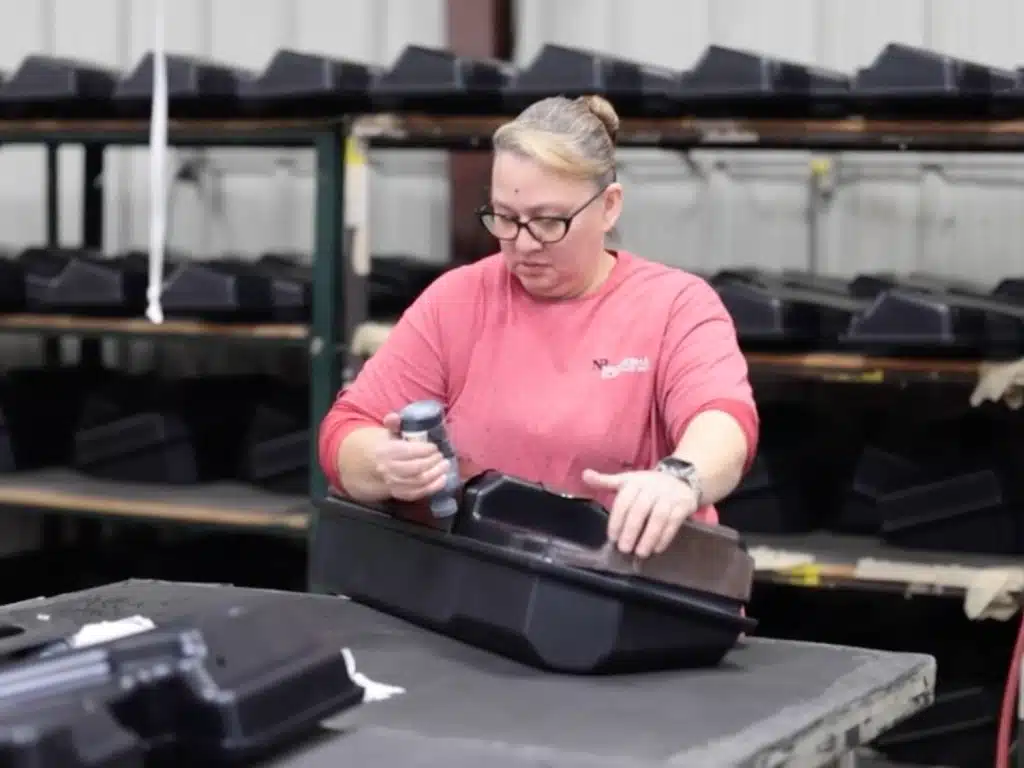
Our commitment to quality and innovation is reflected in our state-of-the-art facilities and equipment. We continually invest in the latest thermoforming machines, CNC routers, and quality control systems to ensure we deliver plastic parts that meet the highest standards of precision and reliability. Our production environment is designed for efficiency and cleanliness, supporting consistent output and minimizing the risk of defects.
Every stage of our thermoforming process is monitored by a robust quality control system, ensuring that each custom part meets or exceeds customer expectations. This dedication to excellence has established us as a trusted leader in the thermoforming industry, known for delivering custom solutions with unmatched accuracy and consistency. When you partner with us, you benefit from advanced technology, expert craftsmanship, and a relentless focus on quality.

Partner with Neodesha Plastics and take the next step towards precision, reliability, and customized thermoforming solutions. We are ready to review your project requirements and provide a fast, detailed quote tailored to your needs. Request a quote today and turn your design into reality.
We serve OEMs and tier suppliers across demanding industrial sectors, including automotive (interior trim, HVAC ducting, under-hood panels), medical and life sciences (diagnostic housings, sterilizable trays), material handling and industrial equipment (machine guards, rugged bins, protective covers), marine (UV-resistant enclosures, flotation modules, dashboards), and commercial/retail (signage, shelving, electronics housings).
Engaging our engineers early in the design phase aligns part geometry, material selection, and tooling strategy with your performance and budget goals before prototypes are built. Through DFM collaboration, simulation, and rapid prototyping, we anticipate manufacturing constraints upfront—accelerating time-to-market, minimizing costly mid-project revisions, and ensuring a smooth transition to full-scale production.
We frequently form common thermoplastics like ABS, PETG, polycarbonate, HMPE, and acrylic, alongside advanced performance materials including TPO, TPE, Royalite, Kydex, Boltaron, Solarkote, Luran, and chrome-laminated ABS. Material selection is driven by your part’s operating environment and regulatory requirements—such as impact resistance, UV and saltwater stability, chemical resistance, flame retardancy, cleanability for medical sterilization, or aesthetic surface finish.
Custom thermoforming is best suited for medium-to-large, durable components such as equipment housings, protective covers, interior and exterior vehicle panels, industrial trays, diagnostic enclosures, and marine dashboards. Because thermoforming uses single-sided tooling, it excels at producing parts with large surface areas, complex contours, and tight dimensional tolerances at a fraction of injection molding tooling costs.
Buyers can leverage heavy-gauge flat-sheet forming for mid-to-high-volume production runs, supported by in-house mold design and rapid prototyping. Depending on part geometry and aesthetic needs, we offer both vacuum forming (ideal for cost-effective, larger parts with softer radii) and pressure forming (which uses high-pressure air to achieve crisp, injection-molding-level detail, sharp edges, and textured finishes).
Beyond forming, we provide end-to-end finishing and value-added services to deliver assembly-ready components. Our post-forming capabilities include precision 5-axis CNC trimming and routing, drilling cutouts, integrating mounting hardware and inserts, applying decorative or functional surface finishes, and sub-assembly—eliminating the need to manage multiple secondary vendors.